Research Article | | Peer-Reviewed

Determinants of Corporate Environmental Reporting: Evidence from Sri Lanka

Received: 28 January 2026     Accepted: 10 February 2026     Published: 14 April 2026
Views:       Downloads:
Abstract

The study aims to examine the level of Corporate Environmental Reporting (CER) in relation to corporate characteristics and to identify differences in CER across industry sectors on the Colombo Stock Exchange (CSE). Despite many previous studies on CER practices in developed countries, there is a knowledge gap in less developed countries with low CER status. The study uses descriptive analysis and the Random-Effect Model (REM) for data analysis and hypothesis testing, based on annual reports from 143 listed companies on the CSE from 2017 to 2021. The findings reveal that Sri Lanka has an average level of CER, with the highest level in the Consumer Goods Sector and the lowest in Possession Processing Services. Further, the study identifies that firm size, the use of global standards, and industry sector are determinants of CER, whereas multinational ownership, profitability, and leverage are not associated with CER. The paper has implications for practitioners and policymakers for improving sustainability reporting in developing countries by identifying characteristics that drive CER. This paper is one of the few attempts to use a significantly larger sample to analyse differences in CER in various sectors of CSE.

Published in Journal of Finance and Accounting (Volume 14, Issue 2)
DOI 10.11648/j.jfa.20261402.14
Page(s) 115-138
Creative Commons

This is an Open Access article, distributed under the terms of the Creative Commons Attribution 4.0 International License (http://creativecommons.org/licenses/by/4.0/), which permits unrestricted use, distribution and reproduction in any medium or format, provided the original work is properly cited.

Copyright

Copyright © The Author(s), 2026. Published by Science Publishing Group

Keywords

Corporate Environmental Reporting, Global Reporting Initiative Guidelines, Listed Companies, Sri Lanka, Corporate Characteristics

1. Introduction
There has been mounting attention to climate change and the diversity of environmental complications, such as global warming, high carbon emissions and natural disasters, since the last few decades of the twentieth century . Freeman (1984) has stated that with the development of the stakeholder theory, firms became liable not only to their shareholders but also to employees, customers, suppliers, the environment and society. Consequently, environmental and sustainable reporting has been developed as a solution for the above environmental challenges in the business literature, and corporations have started proactively engaging in Corporate Environmental Reporting (CER) to overcome future financial and socioeconomic issues .
The announcement of the International Sustainability Standards Board by the International Financial Reporting Standards Foundation at the COP26 conference is one such instance of demonstrating how much global players is concerned with sustainability disclosure . Furthermore, companies are moving towards sustainability reporting from traditional financial disclosure to prove their legitimate performance and to meet stakeholder expectations . In addition, authorities in many countries have also pulled their consideration to CER due to increasing environmental challenges . According to KPMG , 80% of companies worldwide have adopted sustainability reporting practices. The Global Reporting Initiative (GRI) framework is the most recognised for evaluating CER because GRI is recognised as a well-known guideline for CER . Hence, it is imperative to examine the company-level CER within the nation using a globally recognised guideline and its connection with firm-level characteristics.
Moreover, identifying the association between CER and corporate characteristics is crucial because it will motivate the stakeholders and authorities to guide companies to implement environmentally friendly corporate practices . According to Islam et al. , corporate performance indicators are a key element when companies develop an environmental security policy.
Thus, the current research extends its scope to investigate the relationship of CER with corporate characteristics such as corporate size, multinational ownership, profitability, liquidity, use of global CER standards and industry sector. Likewise, to study the sectoral variances in CER, it is vital to select a substantially bigger sample covering all the economic sectors . This will help the specialists and stakeholders comprehend which sector is more accountable to the environment and recognise whether environmentally sensitive sectors are paying closer attention to CER.
In CER, firms are obliged to unveil their financial and non-financial related information to the public to express their accountability to the whole society and natural environment, satisfy stakeholder and legal requirements, acquire good media exposure, enhance the company image, and appeal to future clients and consumers . Nonetheless, according to the literature, CER is primarily a voluntary exercise and not a compulsory practice in several nations, including Sri Lanka .
Among the developing nations, Sri Lanka is a low-middle-income country experiencing prolonged economic and environmental issues such as air pollution, water pollution, land degradation, eradication of biodiversity, and a deprived waste management system. Hence, corporations are encouraged by the authorities to implement sustainable practices by imposing various environmental regulations and policies to monitor corporate activities, but there is a dearth of locally developed CER standards in the country . In addition, only a few studies in Sri Lanka have investigated CER using globally accepted criteria, and none of the studies have used a significantly large sample to investigate CER differences in various industry sectors and analysed the trend over time. For instance, Dissanayake et al. considered several corporate characteristics and sustainability reporting; however, their focus on environmental disclosure was just as segment of broad CSR-related reporting without referring to a globally accepted reporting standard. Although in a similar study, Nuskiya et al. considered the GRI framework, the study's focus is more on corporate governance than the impact of corporate characteristics. Most importantly, both studies have only considered less than 100 listed companies as their sample. Accordingly, this study aims to identify the CER levels of 143 listed companies in Sri Lanka for five years. Further, to examine the differences in CER among various industry sectors in the Colombo Stock Exchange (CSE) and investigate the association between CER and corporate characteristics.
There is no mandatory CER requirement in Sri Lanka, not even for listed companies; thus, the companies' CER efforts are purely voluntary. Despite the lack of regulatory governance, there are recognizable CER advocating efforts by the regulators, such as the Security and Exchange Commission, CSE Central Bank of Sri Lanka, and also by institutes such as the Chamber of Commerce, Professional Accounting bodies, certifying bodies and Universities. Among these initiatives is the implementation and promotion of the code of best practices on corporate governance issued jointly by the Securities and Exchange Commission and the Institute of Chartered Accountants of Sri Lanka in 2013, which requires CER following well-established standards, such as the GRI standards, National Green Reporting System of Sri Lanka and AA 1000 Framework Stakeholder Engagement Standard. Further, The Central Bank of Sri Lanka encourages all licensed banks to disclose the sustainability impact of their operations, following an internationally recognised framework. In addition, the Exchange brought a new listing rule in 2023, mandating all listed companies to have ESG (Environmental, social and governance) policy on their website. Several awarding programs organized by institutes such as the Ceylon Chamber of Commerce and professional accounting bodies to recognise and reward companies championing CER have also contributed to the growth of the country's sustainability reports. With the contribution of these initiatives, CER in Sri Lanka has witnessed a slow but gradual increase, whereby 20% of companies (59 firms) were reporting using GRI guidelines in their annual reports in 2015, and this figure has only increased to 27% (77 firms) by 2023 .
According to the Environmental Performance Index, Sri Lanka was ranked 109th out of 180 countries in 2020, and the rank worsened in 2022 to 132nd . Corporates can be identified as one of the main contributors to a country's environmental performance. Therefore, corporations should be accountable for the natural environment, and their environmental-related activities should be transparent to stakeholders. However, according to the KPMG survey in Sri Lanka, the level of sustainability disclosure in company annual reports is 66%, which is lower than the global average and other nations in the region (Table 1). According to many scholars, this is mainly due to the voluntary nature of sustainability disclosure and the shortage of CER standards . Moreover, in Sri Lanka, motivation and encouragement for firms to include CER in annual reports are lacking, possibly due to the lack of existing knowledge on the relationship between CER and firm characteristics. Accordingly, Sri Lanka provides a unique opportunity to investigate the CER practices and their determinants, specifically in a low-disclosing country.
Table 1. Sustainability Reporting Level of Companies.

Sri Lanka

World

Asia Pacific

India

Pakistan

Sustainability Reporting Level of Companies

66%

80%

84%

98%

90%

Source: KPMG
Several scholars have selected sustainability reporting in Sri Lanka as their research scope but not CER specifically. In addition, these studies have employed content analysis in various ways to quantify the CER such as characters, words and sentences than using globally accepted standards or indicators to measure CER. Therefore, the current study on measuring the CER has identified a significant knowledge gap in the existing literature in Sri Lanka. Further, recognising corporate characteristics that have a relationship with CER is important to acquire the necessary attention of the corporations and authorities on CER. For instance, if GRI adoption is proven to have a relationship, authorities can take initiatives to popularize such standards to promote CER. Also, a relationship between financial characteristics such as profitability and liquidity was found; future firms will be more encouraged to improve CER to demonstrate their financial stability.
Considering the above literature gaps, the current study addresses the research questions: (i) What is the level and trend of CER in the annual reports of the selected listed corporates in Sri Lanka for the selected five-year period? (ii) Is there any difference in the level of CER among various industry sectors in CSE, and (ii) What is the association between CER and corporate characteristics? For the above purpose, the study uses secondary data collected from annual reports of 143 listed companies in the CSE for the period from 2017 to 2021 and employs descriptive analysis and a Random-Effect Model (REM) to analyse the data.
The study findings indicate that the average level of CER for the sample during the study period was 16.2% and that there was an increasing trend in CER during the period 2017-2019. Moreover, the study discovers the highest level of CER in the Consumer Goods Sector (19.6%) and Information Processing Services Sector (20.3%) and the lowest in the Possession Processing Service Sector (10%). Further, the study identifies that firm size, usage of globally accepted CER standards and Industry sectors are determinants of CER. In contrast, profitability and leverage have no association with CER.
The current study contributes to the existing body of knowledge in CER under two perspectives: academic and practical significance. Under academic significance, the study uses GRI as a guide to measuring the level of CER, which similar studies in the Sri Lankan context have rarely been used, which improves the validity of the research and permits to compare the finding with similar studies in other countries . Moreover, the past studies using GRI to measure CER have only considered the companies that have adopted the GRI index in their annual reports when selecting the sample . However, the current study shows that despite adopting the GRI index in the annual reports or not, all listed companies in the CSE have an equal chance of getting selected into the sample, which can result in more generalized findings. Finally, the current study contributes to the existing body of CER literature in Sri Lanka by investigating the trend in CER from 2017 to 2021, comparing the CER practice among different sectors in the CSE, and identifying the association between CER and corporate characteristics. Most importantly, the current study attempts to test the hypothesis developed through triangulation of three theories, namely stakeholder theory, legitimacy theory and institutional theory, which further signifies the study's originality, as most previous studies are based on a single theory. Next, practical significance, understanding the relationship between CER and corporate characteristics such as firm size, profitability, and liquidity will encourage the management to understand what drives environmental performance and adopt CER in their annual reports. Further, as Sri Lanka is a country with voluntary CER and prolonged environmental issues, the study will provide insight for the authorities, such as CSE, to advocate mandatory CER requirements and standards (Ullah et al., 2013). Furthermore, the study provides guidance for the stakeholders, especially the investors, to evaluate the environmental performance of the companies through their CER practices.
The rest of the paper is structured as follows: the second section will provide a critical review of existing literature in the study area with the theoretical background, followed by the research methodology in the third section. The fourth includes the results and discussion. The final section concludes with the paper and provides recommendations and study limitations.
2. Literature Review
2.1. Corporate Environmental Reporting
CER originated in the 1970s in Norway after the emergence of environmental accounting . CER was developed as a part of sustainability reporting, which includes disclosure of company activities on the environment, governance and society . In academic literature, CER has been defined in numerous terms. Gray et al. define CER as the exercise of unveiling the effects of a firm’s practices on the environment and arrangements taken to mitigate the impact. According to Rajapakse , measuring the firm’s achievements in recognising, managing and regulating the environmental impact is the critical objective of CER. Moreover, the Ministry of the Environment has specified that the main goal of CER is to convey a company’s accountability for environmental efforts and its functions. Hence, CER can be identified as a practice of disclosing information on corporate activities related to the environment and steps taken to monitor and manage the environmental impact.
According to different scholars, several items needed to be included in CER, such as environmental management system, environmental policy, information on corrective measures of environmental impacts, and capital expenditure on environmental initiatives. On the other hand, the GRI index is recommended by several researchers as a framework for CER . Since GRI supports corporates to take accountability for their activities by disclosing them through a globally accepted language, the current research will also use the GRI standards to quantify the CER .
2.2. Theoretical Background
Accounting theories and research in recent years have taken a turn to build upon organisational, social, and phycology theories due to the critical importance of an organisational and social context . Many problematic aspects explored through accounting research concern behavioural, social, and coordination issues, which can be approached intellectually through organisational and sociological theoretical traditions . Institutional Theory, stakeholder theory , contingency theory , and natural resource-based theory are some such popular theories used in recent literature.
It is often challenging to explain the reality of a particular phenomenon through a single theory. It would provide a singular and restricted facet for a complex issue; thus, it is recommended to triangulate multiple theories to avoid these limitations . Especially in accounting research, theoretical triangulation sheds light on the role and usage of accounting information and practices through diverse lenses. The usage of several theories allows the researcher to build and modify the existing theories by interpreting empirical data rather than filtering and forcing data to fit into a single theory . Humphrey & Scapens advocate this approach for accounting research where “research becomes driven by problems and issues relating to accounting practice, rather than by the concerns of social theorist” (p. 100). This research draws on stakeholders, legitimacy, and institutional theory to develop the conceptual model to investigate the research questions.
2.2.1. Stakeholder Theory
Stakeholders are a group of people who are interested in the organization’s activities and who can hinder the achievements of the organisation . Hence, stakeholder theory asserts the relationship between an organisation and its stakeholders and claims that an organisation should create value not only for shareholders but also for stakeholders . Organizations’ stakeholders have unequal powers over the firm and have conflicting demands over information . Therefore, corporates should use managerial strategies to maintain a good relationship with salient stakeholders by disclosing specific information . Additionally, stakeholder theory recognizes the stakeholders’ right to know information about the firm’s activities related to the environment and asserts that managers should strategically utilize this information to manage their affiliation with the stakeholders . Thus, companies utilize CER to improve stakeholder association . Based on the stakeholder theory, corporate characteristics such as firm size, profitability, liquidity and usage of globally accepted CER standards can be identified as determinants of CER . For instance, larger companies with higher profitability are likely to disclose more information, including environmental-related information because these companies might comprise more powerful stakeholders who are demanding more information .
2.2.2. Legitimacy Theory
Legitimacy theory can be identified as the most cited theory in the body of CER literature . As per the legitimacy theory, corporations are expected to behave in a desirable, proper and suitable manner within society, and they reveal their activities related to society to express their legitimate performance. Tregidga et al. have stated that legitimacy is a socially constructed impression of the external stakeholders that could be managed proactively. Hence, companies utilize CER, especially in annual reports, to demonstrate their legitimate behavior toward society and the environment . The final goal of strategic legitimacy through CER is to display transparency and accountability toward environmental activities and attract more customers and investors . Nevertheless, previous studies have shown that companies in different industry sectors with different corporate characteristics have a variation in the nature and pattern of CER . In other words, the level of accountability and sensitivity towards the natural environment differs for different sectors . Therefore, the current research will use legitimacy theory to describe the CER in different sectors.
2.2.3. Institutional Theory
Institutional theory is another theory referred to by previous research to explain sustainability-related corporate practices. DiMaggio & Powell proposed that institutional isomorphism holds that organisations tend to implement changes to comply with social norms and acceptable behavior. The purpose behind adhering to the pressure from external demands and expectations is to ensure legitimacy. According to DiMaggio & Powell , organisational responses are mostly driven by their desire to confirm generally acceptable standard behavior rather than their need to make the most efficient or rational choices. Institutional theory has been frequently used in past studies to justify the strategies and practices as a response to sustainability concerns . Particularly in accounting research, this has been the theoretical base to explain the motives behind information disclosure related to CSR and Sustainability . The theory proposes three mechanisms: coercive, mimetic and normative, as the pressure to reach isomorphism. The current study also refers to these three forms of pressure to explain the association between corporate characteristics and CER.
2.3. Hypotheses Development
Previous literature has investigated the relationship between CER and different corporate characteristics such as corporate governance, firm size, profitability, leverage, liquidity and market performance and has obtained mixed results. Hence, the current study considers the firm size, multinational ownership, profitability, liquidity, usage of CER standards and industry sector as corporate characteristics, and in the following section, literature related to each characteristic is reviewed.
CER and Firm Size.
Under stakeholder theory, firm size is considered a determinant of CER and argues that larger companies are more likely to disclose more information . Because larger companies tend to have a large number of stakeholders, they need to disclose more information to satisfy the expectations of most of the stakeholders . According to the legitimacy theory, larger firms are subject to more scrutiny than smaller firms, thus having more incentives to disclose information related to environmental initiatives and impact. In addition, the institutional theory also aligns with the argument that larger firms are subjected to many different constituents that pressure them to conform to prevailing laws, standards and norms of acceptable reporting practices . However, prior studies have shown mixed results regarding the links between CER and firm size. For instance, Garg and Kumar and Nuskiya et al. have identified a positive relationship between CER and firm size, while Dissanayake et al. and Asrori et al. have found a positive association between sustainability reporting and firm size. These studies acknowledge the stakeholder theory argument. On the other hand, Ortiz-Martínez et al. confirms that the non-financial reporting of small and medium enterprises aligns with those of large companies despite the specific characteristics derived due to their size. However, some studies have not discovered a significant association between the above two variables .
Moreover, a Sri Lankan study also found a negative relationship between CER and firm size and concluded that the small sample size might be the reason for the inconsistency with the theory . All the studies mentioned above have used many variables to measure the firm size, such as total assets, total sales, the number of employees and market capitalization . The current study uses total assists as proxies for firm size and develops the following hypothesis to examine the association between CER and firm size:
H1: There is a significant relationship between CER and Total Assets of listed companies in Sri Lanka.
CER and Company Ownership
The ownership status as a corporate characteristic has been defined in various categories in environmental accounting research as public limited/listed or private limited/unlisted , government-owned or privately owned , local or foreign (Multinational) . The ownership status has been defined in the current study as local or foreign-owned companies, considering all companies in the sample are privately owned listed companies. González‐Benito & González‐Benito present the argument for multinational subsidiaries being more proactive in environmental management due to (i) access to knowledge transferring among the group of companies allows quick imitation of successful subsidiaries due to mimetic institutional pressure, (ii) adoption of stringent groupwide policies covering multiple countries' regulatory requirements as per stakeholder theory and legitimacy theory. However, some studies present opposing arguments; for instance, the pollution heaven logic depicts that highly polluting multinational corporations move to developing countries due to the lenient environmental rules and regulations . Past research has provided mixed arguments regarding internationalization as a driver for sustainable business practices. Some previous studies find a positive association between multinational ownership and CER. In contrast, Dissanayake et al. and De Grosbois fail to find a significant influence of multinational ownership on sustainability and CSR reporting. Focusing specifically on CER, the current study tests the following hypothesis,
H2: There is a significant relationship between CER and Multinational ownership of listed companies in Sri Lanka.
CER and Profitability
Here also, previous literature has mixed results about the association between CER and the profitability of the company and has mainly used Return of Equity (ROE) and Return on Assets (ROA) as proxies to measure firms’ profitability . According to the legitimacy theory, corporations with higher profitability tend to disclose more financial and non-financial information because they must maintain a reputation and a brand image to continuously earn profits . Further, Khan et al. have mentioned that profitability permits corporations to allocate more resources to reveal environmental information. In aligning with the above arguments, Asrori et al. , Nimanthi and Priyadarshanie , Nuskiya et al. , and Ullah et al. have identified a positive association between CER and firm profitability. On the other hand, Braam et al. , Garg and Kumar have found no relationship, and Smith et al. have found a negative relationship between the two variables. By considering past empirical findings, the study uses ROE as the proxy to investigate the association between CER and profitability and develop the following hypothesis.
H3: There is a significant relationship between CER and ROE of the listed companies in Sri Lanka.
CER and Liquidity
A limited number of studies have considered firms’ liquidity level as a determinant of CER and showed mixed results in association with CER. Ika et al. have stated that the higher the firm’s liquidity level, the higher the chance of quickly converting its assets into cash and using it on environment-related activities, thereby disclosing it in annual reports. The above argument is supported by Fabian and Emeka Omaliko and Philips . Fabian and Emeka also stated that firms with higher liquidity have a greater incentive to disclose more about their ability to meet financial and non-financial targets, including environmental targets. Conversely, Ho and Taylor have identified a negative relationship, and Garg and Kumar have found no relationship between CER and firms’ liquidity. Additionally, none of the Sri Lankan studies have considered firms’ liquidity as a determinant of CER. Hence, the current study investigates the relationship between CER and firms’ liquidity by taking the current ratio as a proxy, and the fourth hypothesis of the study is as follows:
H4: There is a significant relationship between CER and the current ratio of the listed companies in Sri Lanka.
CER and Usage of GRI Standards
The quality and the quantity of CER varies among corporations and countries due to the absence of proper standards to disclose environment and sustainability-related information , and most companies are experiencing low-level CER in their annual reports due to its voluntary nature . GRI is a globally accepted standard for sustainability reporting, and it provides principles and guidelines along with a list of disclosure items and key performance indicators for public, private and non-profit organisations to voluntarily use in sustainability reporting . Kuzey and Uyar have pointed out that corporations can reveal more relevant social and environmental-related information to their key stakeholders by disclosing sustainability information using GRI standards. According to institutional theory, due to mimetic pressure, firms tend to imitate the actions of successful firms that adopt GRI standards, and due to normative pressure, GRI standards are becoming the norm for reporting CER . Further, Dissanayake et al. , also identified that firms that use GRI standards disclose a higher volume of sustainability information in their annual reports. But the above study’s analysis was limited to 84 listed companies in the CSE, Sri Lanka for the period 2012 to 2015. Due to the existing knowledge gap, the current study extends its analysis to investigate the relationship between CER and the usage of CER standards by capturing a larger sample size for a period of 5 years. Accordingly, the fifth hypothesis of the study is:
H5: There is a significant relationship between CER and GRI usage of the listed companies in Sri Lanka.
CER and Industry Type of the Company
Past studies related to sustainability reporting have extensively considered the nature of industry or industry-specific characteristics as corporate characteristics. Environmental sensitivity varies from industry to industry. Environmental sensitivity has been defined as an industry's ability to negatively impact on the environment directly or indirectly . Industries such as Chemicals, Transportation, Coal, Plantation, Mining and Resources, Petroleum, Property and industrial products have been considered sectors with high environmental sensitivity by many scholars in past environment accounting-related studies . Environmental sensitivity of the industry would drive CER because the greater the environmental sensitivity, the higher the pressure from environmental and other lobby groups; thus, organisations attempt to disclose information as a strategy to defend legitimacy . Organisations pressurized to disclose sustainability information need to implement information systems to assess sustainability impact and control systems to reduce the said impact. Maas and Rosendaal and Otley recognised this as an outside-in approach to integrating sustainability-related reporting, assessment, management control and accounting. Thus, it is safe to presume that firms in high-polluting industries are taking more initiatives to monitor, assess, record, control and report environmental information.
Previous studies considering the industry sector and CER have contradictions in their findings. For instance, Burgwal and Vieira have found a significant positive relationship between Industry membership and environmental disclosure, whereas da Silva Monteiro & Aibar‐Guzmán, D’Amico et al. and Gao et al. have failed to discover any such significant association. Confirming the latter, Dissanayake et al. and Nuskiya et al. also fail to find a significant relationship between the difference in the industry sector and CER, especially in the Sri Lankan context. However, these studies have only selected a few industries in the CSE and selected a smaller sample size. Therefore, to retest the association between industry sectors and CED, the sixth hypothesis of the study is formulated,
H6: There is a significant relationship between CER and the Industry type of the listed companies in Sri Lanka.
3. Methodology
3.1. Population and Sample
The study population comprises 288 listed CSE firms as of 20th May 2022. The sample size has been identified using Morgan’s table under a 5% error margin and 95% confidence interval. According to Morgan’s table, the initial sample size was 165. In the CSE, companies are registered under 20 industry categories according to the GICS (Global Industry Classification Standards). Due to the number of companies listed under some industry groups, the researcher uses a stratified random sampling method under a systematic approach to select the sample . First, these industry groups are divided into two strata: Goods-related industry and Services-related industry. The goods-related industry groups are again divided into two strata: the Consumer Goods Sector (CGS) and the Industrial Goods Sector (IGS) . The Services related industry groups are again divided into three strata: People Processing Services (PEPS), Possession Processing Services (POPS) and Information Processing Services (IPS) . The number of listed firms under GICS and the number of sample units in each stratum are demonstrated in Table 2.
Table 2. Sample Selection.

GICS Classification

No. of companies

Stage 1: Strata

Stage 2: Strata

Sample Units

Automobiles & Components

1

Goods

Industrial Goods (IGS)

34

Capital Goods

29

Materials

21

Utilities

8

Consumer Durables & Apparel

13

Consumer Goods (CGS)

45

Household & Personal Products

2

Retailing

14

Food & Staples Retailing

3

Food, Beverage & Tobacco

47

Consumer Services

36

Services

People Processing (PEPS)

25

Health Care Equipment & Services

8

Transportation

3

Possession Processing (POPS)

19

Commercial & Professional Services

7

Real Estate

20

Energy

2

Software & Services

1

Information Processing (IPS)

42

Telecommunication Services

2

Banks

12

Diversified Financials

47

Insurance

12

Population size

288

Initial Sample Size

165

Finally, the study considers the following conditions when randomly selecting the sample units.
1) Annual reports need to be published on the CSE website
2) Annual reports need to be available for the study period
3) Data for the proxy variable needed to be available in the annual reports
After applying the above selection criteria, 22 companies were excluded due to the unavailability of annual report data that met the study requirements. Consequently, the final sample comprised 143 companies, representing 49.7% of the total population. The study deals with balance panel data series, and the secondary data is collected from the annual reports of the selected sample for the period of 2017-2021. The study uses annual reports to collect firm-level data because it is mandatory to publish annual reports for the listed firms in CSE .
3.2. Operationalization
3.2.1. Dependent Variable
The study’s dependent variable is the CER index, and the content analysis is utilized to calculate the CER index with the dichotomous procedure under GRI guidelines. Content analysis is the commonly used technique in the CER-related body of knowledge , and this technique can be used to collect data under predetermined criteria by codifying qualitative and quantitative reporting information . Under content analysis, past scholars have used different units of measure to calculate the CER index, such as word count , number of sentences , and page proportions . In contrast, some researchers have calculated the environmental reporting status by only considering whether a company prepared a sustainability report . However, these measures may not be the most appropriate method to capture CER because the number of characters, words, and sentences ignores non-narrative disclosure and focuses more on quantifying disclosures than on disclosures’ quality. To overcome this issue the current study is using content analysis under GRI guidelines which is a globally accepted criteria to measure CER. Furthermore, several researchers also have recommended GRI standards to measure the quality of the CER as well . GRI standard is used to assess CER in current research as well because as per Dissanayake et al. many listed firms at CSE are occupying the GRI guidelines to prepare their annual reports. To measure the dependent variable, “CER index” was calculated by conducting a content analysis. A disclosure score was developed to quantify the extent of environmental disclosure under predefined determinants. To ensure coding reliability, a systematic content analysis procedure was followed. Both researchers were involved in collecting data for content analysis and applied the checklist to a randomly selected subset of annual reports. Inter-coder reliability was assessed using Cohen’s Kappa, with values exceeding 0.80, indicating a high level of agreement and ensuring consistency and objectivity in the measurement of CER. Any discrepancies were resolved through discussion and consensus, and the remaining reports were coded accordingly. The study uses 30 environmental-related codes with specific descriptions as per GRI Guidelines (Table 3) to calculate the CER index.
Table 3. Codes and Descriptors according to GRI Guidelines.

Global Reporting Initiatives Standards

Code

Description

Materials

1

301-1

Total weight or volume of materials that are used to produce and package the organization’s primary products and services

2

301-2

Percentage of recycled input materials used to manufacture the organization’s primary products and services

3

301-3

Percentage of reclaimed products and their packaging materials

Energy

4

302-1

Total energy consumption within the organisation

5

302-2

Energy consumption outside of the organisation

6

302-3

The energy intensity ratio for the organisation

7

302-4

Reduction of energy consumption

8

302-5

Reductions in energy requirements of products and services

Water

9

303-1

Water withdrawal by source

10

303-2

Water sources are significantly affected by the withdrawal of water

11

303-3

Water recycled and reused

Biodiversity

12

304-1

Operational sites owned, leased, managed in, or adjacent to, protected areas and areas of high biodiversity value outside protected areas

13

304-2

Significant impacts of activities, products and services on biodiversity

14

304-3

Habitats protected or restored

15

304-4

IUCN Red List species and National Conservation List species with habitats in areas affected by operations

Emission

16

305-1

Direct (Scope 1) GHG emissions

17

305-2

Energy indirect (Scope 2) GHG emissions

18

305-3

Other indirect (Scope 3) GHG emissions

19

305-4

GHG emissions intensity

20

305-5

Reduction of GHG emissions

21

305-6

Emissions of ozone-depleting substances (ODS)

22

305-7

Nitrogen oxides (Knox), sulfur oxides (SOx), and other significant air emissions

Effluent and Waste

23

306-1

Water discharge by quality and destination

24

306-2

Waste by type and disposal method

25

306-3

Significant spills

26

306-4

Transport of hazardous waste

27

306-5

Water bodies affected by water discharges and/or runoff

Compliance

28

307-1

Significant fines and non-monetary sanctions for non-compliance with environmental laws and/or regulations in terms of:

Supplier Environmental Assessment

29

308-1

New suppliers that were screened using environmental criteria

30

308-2

Negative environmental impacts in the supply chain and actions taken

Source: Global Sustainability Standards Board (2016)
In calculating the CER index score for a company, a dichotomous technique was used to measure the CER index value by giving ‘1’ when an item complying with each code is disclosed and ‘0’ otherwise . Accordingly, each company, in a particular year, can score a maximum of 30 points. Out of the 37 GRI environmental indicators, the list was reduced to 30 for the Sri Lankan context due to practical relevance, reporting frequency, and materiality considerations. Indicators were excluded because they are rarely implemented, difficult to quantify, or irrelevant to most local firms. Using the calculated total disclosure score, the CER index value is measured using the formula below:
CER= i=1ndin
CER = Corporate Environmental Reporting Index Value
n = Total Disclosure Items
di = Number of Items Disclosed or not
3.2.2. Independent Variables
The study used six firm-level characteristics as the determinants of CER: firm size, multinational ownership, profitability, liquidity, and usage of CER standards and industry sector. The operationalization table of the dependent and independent variables is given in Table 4.
Table 4. Operationalisation of Variables.

Variable Type

Variable

Proxy variable

Reference

Definition

Measurement

Dependent variable

CER

CER Index using GRI guideline (CER_index)

, 20, 70, 99, 101]

The proportion of disclosed items for a firm in the given period

1 when an environment-related item is disclosed and 0 otherwise

Independent Variables

Firm Size

Ln Total Assets (Ln_TA)

, 7, 47, 70, 72, 101]

Is the sum of both current and non-current assets in the annual report

Natural Log of Total Asset Value (LKR)

Multinational Ownership

MNC

, 46]

Dichotomous procedure: 1 for if a company is a subsidiary of a Multinational operating in Sri Lanka firms 0 otherwise

0 = No 1= Yes

Profitability

ROE

, 7, 100, 102]

How well does the firm generate returns to its equity providers

= PAT / total equity)

Ratio

Liquidity

Current ratio (CR)

12, 43, 48, 71, 108]

Measure the firm’s ability to pay its current liability using its current assets.

=current assets/ current liabilities

Ratio

Usage of CER standards

GRI_usage

40, 87]

Dichotomous procedure: 1 for firms that use GRI guidelines in annual reports and 0 otherwise

0 = No 1= Yes

Industry Type

High Profile Industries Vs Low Profile Industries

, 86, 102]

Dichotomous procedure: 1 for High Profile Industries (IGS, CGS). “0” for Low Profile Industries (PEPS, POPS, IPS)

0 = PEPS, POPS, IPS 1= IGS, CGS

3.3. Analytical Tools
For the data analysis, first, the researcher uses descriptive analysis along with line graphs, pie charts and bar charts. The study employs different types of descriptive analysis: descriptive analysis of the level of CER i) Over time, ii) By sectors and ii) By disclosure theme. Descriptive analysis is useful for a study to identify the basic features of the study variables before employing formal econometric tools.
The study employs the Skewness, Kurtosis and Jarque-Bera tests to determine whether the study variables are normally distributed and whether to use parametric or non-parametric tests in the correlation analysis . The Skewness value should be close to zero, and the Kurtosis value should be close to 3 for the study variable to be normally distributed . The study uses the Jarque-Bera test to reconfirm the normality, where the null hypothesis states that the variable is normally distributed .
The correlation test is usually used to detect the strength and direction of correlation between the study variables and the multicollinearity among the independent variables . Thus, based on the results of the normality test, the study employs Pearson’s (if variables are normally distributed) or Spearman’s (if the variables are not normally distributed) correlation test to examine the correlation .
In panel data analysis, three types of regression models can be used to analyse data: i) Pooled Leased Squares Model (POLS), ii) Fixed-Effects Model (FEM) and iii) Random-Effects Model (REM) . POLS assumes that the intercept (αi) is usually fixed for all independent variables at different times and homoscedasticity across time and cross-sections . At the same time, FEM assumes that the intercept is changing for different independent variables (Xit) without changing the coefficient values it). Conversely, REM assumes that independent variables (Xit) and the coefficients it) are uncorrelated with the intercept.
First, the study runs the POLS model to select the most suitable model and analyses the R-square value, Homoscedasticity, Autocorrelation and Normality test. Next, the study employs the Hausman Test to make the selection between FEM and REM and the decision criteria (H0: REM is more appropriate than FEM).
The model specification of the current study is:
CERit= α+β1Ln_TAit +β2MNCit+β3ROEit+β4CRit+β5GRI_Usageit+β6Sectorit+εit
Where:
CER = Corporate Environmental Reporting
Ln_TA = Natural Logarithm of Total Assets
MNC = Multinational Ownership
ROE = Return to Equity
CR = Current Ratio
GRI_Usage = GRI usage
Sector = Industry Type
α = Intercept
β = Regression Coefficients
ε = Error Term
The study used Microsoft Excel and EViews software packages to execute the above analytical tools for data collection, presentation and analysis.
4. Results and Discussion
4.1. Descriptive Analysis
The current study is based on one dependent variable, the CER index, and six independent proxy variables (Ln_ TA, MNC, ROE, CR and GRI usage, Sector). First, the study employs descriptive statistics to identify characteristics of the study variables, and Table 5 presents the descriptive statistics of the above variables. According to the descriptive statistics, the average level of CER for the sample during the study period is 16.2%. The results are consistent with previous similar studies in Sri Lanka. For instance, Nuskiya et al. have identified the average level of environmental disclosure for 41 listed companies as 14.4% from 2015 to 2019, and Nimanthi & Priyadarshanie have pointed out that the disclosure level among Sri Lankan companies is 20% by studying 50 listed companies for the period between 2015-2018. Moreover, the results also consist of similar studies in the region. Ullah et al. have identified that the average level of CER for listed companies in Bangladesh is around 11%, and Garg and Kumar identified that the average level of CER is less than 20% for Indian corporates. On the other hand, in developed countries such as the Netherlands, the average level of CER is 25.3% . In addition, Table 5 illustrates the GRI usage of sample companies during the study period. Accordingly, only 27.2% of the companies are using GRI guidelines to prepare annual reports during the study period, which is not satisfactory.
Table 5. Descriptive Statistics.

CER_INDEX

LN_TA

MNC

ROE

CR

GRI_USAGE

SECTOR

Mean

0.162132

22.2102

0.09790

0.08214

4.38593

0.272090

0.46993

Median

0.066667

22.2793

0.00000

0.06163

1.26783

0.000000

0.00000

Maximum

1.000000

27.2784

1.00000

4.28350

253.193

1.000000

1.00000

Minimum

0.000000

12.4930

0.00000

-2.1391

0.00313

0.000000

0.00000

Std. Dev.

0.219514

1.7305

0.29739

0.37951

14.36797

0.445348

0.499444

Observations

715

715

715

715

715

715

715

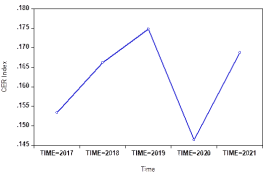
Then, the study employs a line graph to illustrate the trend of CER during the study period. According to Figure 1, there was an increasing trend in CER during the period of 2017-2019, and Nuskiya et al. also confirmed that there was an increasing trend in CER during 2015-2019. However, after 2019, there was a steep drop in CER, which could be due to the COVID-19 outbreak, which has adversely affected the performance of the corporations. Then, again, in 2021, the average level of CER improved to 17%.
Figure 1. Average Level of CER Overtime.
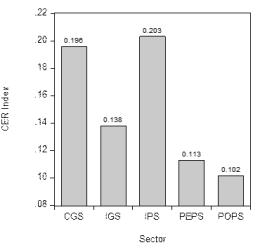
Figure 2 compares the average level of CER by sector during the study period. Based on the figures, the CGS and the IPS Sector record the highest levels of CER, which are 19.6% and 20.3%, respectively. Conversely, the POP sector records the lowest level of CER.
Figure 2. Average Level of CER by Sectors.
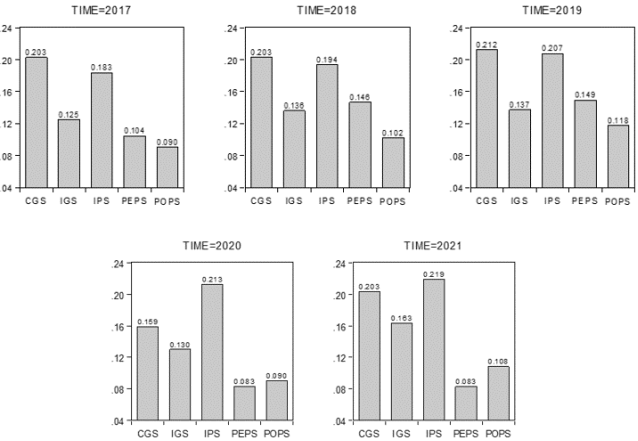
Figure 3 demonstrates the average level of CER by year and by sector. According to the figure, the average level of CER of the five sectors during the study period is more or less similar. However, apart from IPS, the average level of CER has dropped for the other four sectors in 2020, which can be due to the COVID-19 impact. According to The World Bank , IPS, which includes financial, information communication technology (ICT), Knowledge Process Outsourcing (KPO), Business Process Outsourcing (BPO) companies, is the minimally impacted sector in Sri Lanka due to COVID-19. Another interesting fact is that in IPS, the level of CER is improving over time: 2017-18.3%, 2018-19.4%, 2019-20.7%, 2020-21.3% and 2021-21.9%. Given the sector’s comparatively low direct environmental footprint, this upward trend is likely driven less by environmental risk exposure and more by normative and reputational pressures, particularly client expectations, professional standards, and alignment with global sustainability norms. In particular, adherence to internationally recognised frameworks, such as the Principles for Responsible Investment (PRI) and other global reporting standards, creates pressure for IPS firms to enhance transparency and demonstrate responsible business practices.
Figure 3. Average Level of CER by Year and Sector.
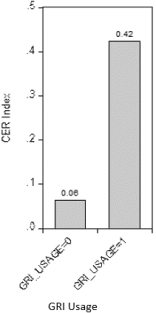
Figure 4 illustrates the average level of CER based on GRI usage. This figure proved that companies that occupy global sustainability reporting standards tend to disclose more environmental-related information in their annual reports than the companies that do not employ global sustainability reporting standards. Here, the average level of CER for companies that have occupied the GRI standards is 42%.
Figure 4. Average level of CER by GRI usage.
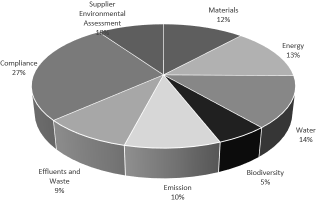
Next, the study employs a Pie Chart to illustrate the CER behavior based on the reporting theme. The researcher has used 30 items under eight themes to calculate the CER scores according to the GRI standards. Accordingly, Figure 5 shows that among the sample companies, the highest level (27%) of environmental-related information is disclosed under “Compliance”, and the least is disclosed under the “Biodiversity” theme.
Figure 5. Average CER by Disclosure Theme.
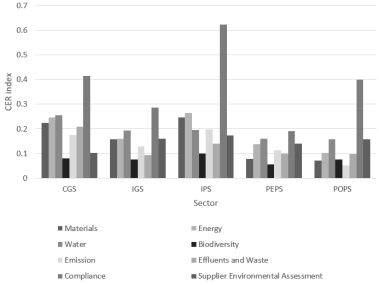
Lastly, the study uses a line graph to understand the level of each reporting theme in all five sectors. Accordingly, Figure 6 shows that for each sector, the highest and the lowest levels of environmental-related information were disclosed under the same themes as for the whole study sample (Compliance and Biodiversity, respectively) except for POPS. Because in POPS, the lowest level of environmental-related information was disclosed under “Emission”.
Figure 6. Average CER by Theme by Sector.
4.2. Statistical Analysis
4.2.1. Correlation Analysis
Based on the results of the normality tests, the study employs Spearman’s correlation analysis as a non-parametric test to detect the strength and direction of the correlation between the study variables. Table 6 presents the results of Spearman’s correlation test. According to the results, only GRI_Usage shows a significant strong positive correlation with the CER index, which is consistent with the results of Dissanayake et al. . Then again, Ln_TA and ROE show a significant weak positive correlation, and CR shows a significant weak negative correlation with the CER index. Moreover, these results are consistent with the correlation test results of Aggarwal and Singh , Dissanayake et al. , Dissanayake et al. , Nimanthi and Priyadarshanie , Nuskiya et al. . In addition, regarding the correlation between the independent variables, the results indicate a weak correlation ranging from 0.121 to 0.435. Hence, the study concludes that multicollinearity is not deemed to influence the robustness of the findings.
Table 6. Correlation Analysis.

CER_INDEX

LN_TA

MNC

ROE

CR

GRI_USAGE

SECTOR

CER_INDEX

1

LN_MC

0.463**

1

MNC

-0.02

-0.082

1

ROE

0.237**

0.211**

0.036

1

CR

-0.222**

-0.259**

-0.036

0.124**

1

GRI_USAGE

0.711**

0.382**

-0.116**

0.200**

-0.200**

1

SECTOR

0.038

-0.139**

-0.074

0.096**

-0.015

-0.045

1

**Significant at 0.001 Level

4.2.2. Regression Analysis
Pooled Least Squared (POLS) Model
To achieve the study’s third objective and test the hypothesis developed in the previous chapter, which is to investigate the relationship between CER and firm characteristics, the study first employs the POLS model. Table 7 presents the results of the POLS model, and by looking at the R-squared value, the study determines that the POLS model is inadequate to estimate the coefficients because the R-squared value of the POLS model is 0.55, which means that only 55% of the dependent variable’s variance can be explained by the independent variables used under this model.
Table 7. POLS Model Results Dependent Variable: CER_INDEX.

Coefficient

Std. Error

t-Statistic

Prob.

LN_TA

0.0175250

0.0035389

4.952114

0.00000

MNC

0.0367203

0.01881245

1.951913

0.05134

ROE

-0.0102637

0.0145636

-0.70475

0.48120

CR

-0.0001701

0.00039078

-0.43537

0.66342

GRI_USAGE

0.3375264

0.01353295

24.94108

0.00000

SECTOR

0.0444038

0.01135799

3.909474

0.00010

C

-0.3418088

0.07915893

-4.31801

0.00002

R-squared

0.5557465

Durbin-Watson stat

0.30483374

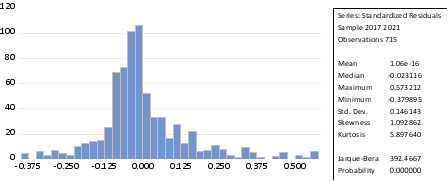
The study uses the Heteroscedasticity and Normality test to confirm the above decision and validate the POLS assumptions. The results of the two tests are given in Table 8 and Figure 7.
Table 8. Panel Cross-section Heteroscedasticity LR Test.

Null hypothesis: Residuals are homoscedastic

Value

df

Probability

Likelihood ratio

1416.876

143

0.0000

Figure 7. Normality Test for Residuals.

According to Table 8 and Figure 7, the p-value of the Likelihood ratio and Jarque-Bera test is less than 0.05 and rejects the null hypotheses (residuals are homoscedastic and residuals are normally distributed respectively). Moreover, in Table 7, the Durban Watson statistic is 0.3, which is lower than two and indicates positive autocorrelation. As per the test results, the study concludes that the POLS model is inappropriate for estimating the variables.
Random-Effect Model (REM)
Next, the study employs REM to estimate the variables and to identify the association between dependent and independent variables. Table 9 presents the results of REM. Before interpreting the model results, the study employs the Hausman test to check the appropriateness of the REM, and the results of the Hausman test are given in Table 10.
Table 9. REM Results.

Dependent Variable: CER_Index

Variable

Coefficient

Std. Error

t-Statistic

Prob.

LN_TA

0.0137677

0.00517649

2.659658349

0.0080**

MNC

0.0167258

0.03816675

0.438230439

0.6613

ROE

0.0020251

0.00749592

0.270157486

0.7871

CR

-0.00031

0.00029639

-1.04603075

0.2959

GRI_USAGE

0.2475261

0.01153344

21.46159864

0.0000**

SECTOR

0.0371292

0.02186625

1.698012328

0.0899*

C

-0.2289501

0.11749093

-1.94866155

0.0517

R-squared

0.9118428

*Significant at 0.05 and **Significant at 0.01

Table 10. Hausman Test.

Null hypothesis: REM is appropriate

Test Summary

Chi-Sq. Statistic

Chi-Sq. d.f.

Prob.

Cross-section random

27.92041

5

0.0547

*Significant at 0.05

The Hausman test produced a p-value of 0.0547, which is slightly above the conventional 5% significance level. Accordingly, the null hypothesis that the Random Effects Model (REM) is appropriate cannot be rejected, and the REM is retained for the main analysis. Although the result is borderline, econometric convention supports model selection based on the predefined significance level. To ensure robustness, results should be interpreted with caution and, where necessary, compared with fixed-effects estimates. Dissanayake et al. also recommended using REM because the model assumes that the entities are random and uncorrelated with independent and time-invariant variables such as GRI usage. Hence, the study can interpret the test results of the REM.
The current study used six independent variables as proxy variables for six firm-level characteristics: Ln_TA to measure firm size, MNC to measure multinational ownership, ROE to measure profitability, CR to measure liquidity, and GRI-Usage to measure usage of global reporting standards and SECTOR for Industry type. REM results for each corporate characteristic are interpreted below.
Table 8 shows that Ln_TA was positively associated with the CER index value at a 0.05 significance level. Therefore, the study accepts the first hypothesis (H1), and there is statistically enough evidence to state a positive association between CER and firm size in the Sri Lankan context. These results are consistent with previous studies such as Asrori et al. , Dissanayake et al. , Garg and Kumar , Nuskiya et al. and contradict with the studies such as Aggarwal and Singh , Braam et al. , Ika et al. . These results contradict a Sri Lankan study that stated a negative relationship between environmental disclosure and firm size . Moreover, this study’s results acknowledge the part of the stakeholder theory that states that larger companies have many stakeholders and are more likely to disclose more information to satisfy the expectations of most of the stakeholders . Further, it confirms the arguments according to legitimacy theory and institutional theory, where larger firms are subject to scrutiny by the public to prove their legitimacy and are more pressured to conform to the regulations, standards and norms.
The REM result shows no significant relationship between the ownership of the listed companies by Multinational Companies and the level of CER, thus rejecting H2. Which implies that the presence of foreign or multinational shareholders does not necessarily translate into higher levels of environmental disclosure. While multinational enterprises are often assumed to transfer superior reporting practices and global sustainability standards to host-country firms, institutional theory suggests that subsidiaries and locally listed firms frequently adapt their disclosure practices to the normative and regulatory expectations of the host country, rather than to the standards of parent firms . The current study findings agree with previous research, such as Aksan & Gantyowati and Haladu & Salim , who also failed to find significant results between these variables. In emerging economies such as Sri Lanka, weak enforcement mechanisms and the largely voluntary nature of environmental reporting may reduce the incentive for multinational-owned firms to exceed local disclosure norms, leading to reporting practices that are like those of domestically owned firms. Moreover, prior studies indicate that multinational firms may prioritize symbolic compliance to maintain legitimacy while limiting substantive disclosure that could expose operational risks or regulatory scrutiny. Consistent with earlier empirical evidence from developing country contexts , the findings suggest that multinational ownership alone is insufficient to drive enhanced environmental reporting in the absence of strong coercive or normative pressures.
REM results indicate a statistically insignificant positive relationship between ROE and the CER index. Hence, the study rejects hypothesis H3 and concludes that profitability is not a determinant of CER in the Sri Lankan context. This result is consistent with the prior studies such as Braam et al. and Garg and Kumar . It contradicts the results of Asrori et al. , Nimanthi and Priyadarshanie , Nuskiya et al. , and Ullah et al. which state that profitability permits corporations to disclose more environmental information. This research finding rejects the argument of both stakeholder and legitimacy theory. According to stakeholder theory, corporates with higher profitability will disclose more environmental-related information due to the powerful stakeholder , Legitimacy theory states that highly profitable firms always try to disclose more information to maintain their brand image and legitimate behavior within society . However, the study's findings can be justified by normative institutional theory, as CER is mainly driven by social norms, professional standards, and shared values rather than by firm-level economic performance . Normative pressures emanating from professional bodies, sustainability frameworks, and industry associations encourage firms to adopt environmental reporting as an ethically appropriate and legitimate practice, irrespective of profitability. Further, empirical evidence from Sri Lanka suggests that such disclosures are often narrative and compliance-oriented, indicating legitimacy-seeking behavior driven by normative expectations rather than profitability differentials .
As per Table 9, CR also has a statistically insignificant negative relationship with the CER index and rejects the fourth hypothesis (H4). Thus, the study concludes that no relationship exists between CER and firms’ liquidity in the Sri Lankan context. The above results are consistent with Garg and Kumar and contradict Fabian and Emeka , Ho and Taylor , Ika et al. , and Philips .
The REM results presented in Table 8 indicate that GRI usage is positively attributed to the CER index at 0.01 significance level. As per the results, the study accepts the fifth hypothesis (H5) and concludes that using globally accepted environmental reporting standards positively impacts CER. Moreover, this result is consistent with prior studies such as Dissanayake et al. and Kuzey and Uyar . It proves that disclosing environmental-related information using global standards allows corporations to reveal more relevant social and environmental-related information to their key stakeholders. The above finding of the study complies with the stakeholder theory, which states that by disclosing environmental-related information using global standards in the annual reports, companies get the chance to reveal the most relevant information to satisfy their key stakeholders. The positive association between GRI usage and CER can also be explained by Institutional Theory. When successful companies use the GRI Index, other companies tend to imitate those practices due to mimetic pressure, increasing the quality of CER than non-GRI users. Also, the growing acceptance of the GRI index as a reporting standard pressurizes firms to report CER information better due to normative pressure .
Lastly, this study also finds a positive association between the Industry Sectors and CER, thus accepting hypothesis H6. The positive association indicated that the corporations operating in industry sectors with higher environmental sensitivity tend to have higher levels of CER. When considering the related studies in other countries, the current study findings agree with but contradict studies such as Most importantly, this study finds contradictory findings to other Sri Lankan Studies (Dissanayake et al., ; Nuskiya et al., ), which fails to find a significant association between industry sectors and CER. The significant association between the Industry Sector and CER can be explained by all three theories. According to legitimacy theory and stakeholder theory, highly polluting industries are more pressurized to report their environmental impact and high scrutiny by their stakeholder to prove their legitimacy than low-polluting industries. Further, under the Sri Lankan legislative farmwork, the rules and regulations imposed on the manufacturing industry (which includes in high profile industries, IGS and CGS are compelled to obtain an Environmental Protection License, which the certificate is issued by evaluating wastewater disposal, noise control, and air pollution control. Thus, high-profile industries are subject to coercive pressure to maintain data-related environmental performance, eventually driving CER.
5. Conclusion
CER is a predominantly voluntary exercise of corporates in many nations, including Sri Lanka. Due to the voluntary nature of the CER, there is a higher chance of generating conflict among the company and other internal and external stakeholders, which can create legitimacy issues among the company and stakeholders. Accordingly, the current research was carried out with the objectives of identifying the level and trend of CER in the annual report of listed firms in Sri Lanka for the last five years, examining the differences in CER among various industry sectors in CSE and investigating the association between CER and corporate characteristics. These objectives were achieved by analyzing the data collected from the annual reports of 143 listed companies in the CSE from 2017 to 2021. The analysis was carried out by employing six study variables, namely, Ln_TA to measure firm size, MNC to measure multinational ownership, ROE to measure profitability, CR to measure liquidity, GRI-Usage to measure usage of CER standard and SECTOR to measure environmental sensitivity of the industry sector.
According to the descriptive analysis, the average level of CER for the sample during the study period is 16.2%, and the level of CER in the Sri Lankan context is similar to other countries in the region but lower than that of developed nations. Moreover, the research also discovered that the average level of GRI usage is 27.2%, and such a lower level of CER can be due to the voluntary nature of the CER in Sri Lanka and not having a specific guideline to disclose environmental-related information in the annual reports. The study also discovered that the highest level of CER was recorded in the CGS (19.6%) and IPS (20.3%), which are higher than the country average, while the lowest was recorded in the POPS (10%) during the study period. REM was selected as the most appropriate model for the study to test the study hypothesis based on the Hausman test results. According to the REM results, the study has accepted the H1, H5, and H6 and rejected the H2, H3 and H4. Based on the above results, the study concludes that firm size and usage of CER standards and Industry Sectors are determinants of the level of CER in annual reports of the listed firms in the Sri Lankan context, and these three corporate characteristics positively impact the level of CER. The correlation analysis results also confirmed the above decision. Conversely, the study concludes that the other three corporate characteristics (Multinational ownership, profitability and liquidity) are not determinants of CER in the Sri Lankan context.
Considering the analytical results and conclusions, the study recommends two major policy implementations to improve the level of CER among the listed companies under the short-term and long-term recommendations. The short-term recommendation of the study is to promote CER using GRI standards grounded on the positive association between the two variables. The study reiterates that the respective authorities, such as the CSE, the National Regulatory Institute, the Central Environment Authority and the Institute of Chartered Accountants of Sri Lanka (ICASL), have a crucial responsibility to promote and improve the CER within the country. Although ICASL has introduced financial reporting standards in Sri Lanka, there is a dearth of mandating locally developed or globally recognised CER standards in the country . In 2011, the Ministry of Environment launched the National Green Reporting System, a framework enabling companies to become transparent through sustainability reporting . In 2019, the CSE released six recommendations for Listed Companies to communicate sustainability . Though Sri Lanka has made some efforts to improve CER among corporations, it seems that these initiatives are not popular among corporations and are not comprehensive enough. Therefore, the study recommends promoting and creating awareness and education on the GRI standards with the support of all respective authorities to acquire firms' acceptance of the standards. This initiative will benefit the listed companies and all corporates by reducing the legitimacy gap and gaining internal and external stakeholder confidence.
The long-term recommendation of the study is to make CER mandatory, or at least mandatory CER for companies operating in industries with high environmental impact. The current study finds a positive association between industry environment sensitivity and CER. Therefore, a mandatory CER policy would not be a big ask to those companies, as most companies in such industries may have voluntarily built the reporting practices. Initiating mandatory reporting in high-impact industries would set the benchmark for companies operating in other industries and eventually make it mandatory for all listed companies. Advanced countries such as Australia, Canada, France, Singapore and China have a mandatory CER practice . Further, there will be various positive impacts of mandatory CER. For instance, CER will incentivize foreign investors to come into the country, corporations will become more accountable for their business activities, and corporations will be encouraged to take corrective action whenever there is a negative environmental impact. Policymakers and regulators, including the Colombo Stock Exchange and relevant line ministries, also should develop sector-specific environmental reporting guidelines aligned with national sustainability priorities and the GRI. Incentive-based mechanisms, such as preferential access to green financing, fiscal concessions, or recognition under national sustainability awards, could further encourage deeper and more consistent environmental disclosures within these sectors. Moreover, the reporting practices of consumer and industrial goods manufacturers can serve as benchmark standards for less environmentally exposed industries, facilitating the diffusion of environmental reporting norms across the Sri Lankan corporate sector. Such targeted policy interventions would strengthen the credibility, comparability, and overall quality of environmental reporting while supporting Sri Lanka’s broader sustainability ambitions.
Regardless of the significant contribution of the study, the following limitations can be identified. First, the study relies on annual reports to collect data and measure CER. However, annual reports might not be the only disclosure medium for corporations . Therefore, the study will not completely picture corporate CER practices. Second, the study employs content analysis based on the GRI index to measure CER under the assumption that GRI captures the quality aspect of CER . Nevertheless, the study quantifies the CER in annual reports, and the quality of CER is limitedly measured . Lastly, as corporate characteristics, the study only considers the usage of CER standards, firm size, ownership, profitability, liquidity and industry sector. Future studies can be extended to measure the association between other characteristics, such as firm leverage and efficiency. Considering the study scope and limitations, future scholars can conduct research and use other sources, such as company websites and sustainability reports, to collect secondary data on CER. In addition, to have a broader view of the determinants of CER, future researchers can expand the study scope to investigate the stakeholders’ perception of CER by collecting primary data through questionnaires and interviews.
Abbreviations

CER

Corporate Environmental Reporting

CSE

Colombo Stock Exchange

REM

Random-Effect Model

GRI

Global Reporting Initiative

ESG

Environmental, Social and Governance

ROE

Return of Equity

ROA

Return on Assets

GICS

Global Industry Classification Standards

CGS

Consumer Goods Sector

IGS

Industrial Goods Sector

PEPS

People Processing Services

POPS

Possession Processing Services

IPS

Information Processing Services

POLS

Pooled Leased Squares Model

FEM

Fixed-Effects Model

Ln_TA

Natural Logarithm of Total Assets

MNC

Multinational Ownership

CR

Current Ratio

ICASLL

Institute of Chartered Accountants of Sri Lanka

PRI

Principles for Responsible Investment

Author Contributions
Navoda Dhanangika Edirisinghe: Conceptualization, Data curation, Formal Analysis, Writing – original draft
Udani Chathurika Edirisinghe: Conceptualization, Investigation, Methodology, Supervision, Writing – review & editing
Conflicts of Interest
The authors declare no conflicts of interest.
References
[1] Abdul-Rashid, S. H., Sakundarini, N., Ghazilla, R. A. R., & Thurasamy, R. (2017). The impact of sustainable manufacturing practices on sustainability performance: Empirical evidence from Malaysia. International Journal of Operations & Production Management, 37(2), 182-204.
[2] Adams, C. A., & Larrinaga‐González, C. (2007). Engaging with organisations in pursuit of improved sustainability accounting and performance. Accounting, Auditing & Accountability Journal, 20(3), 333-355.
[3] Ahmad, Z., Hassan, S., & Mohammad, J. (2003). Determinants of Environmental Reporting in Malaysia. International Journal of Business Studies, 11(1).
[4] Aggarwal, P., & Singh, A. K. (2019). CSR and sustainability reporting practices in India: an in-depth content analysis of top-listed companies. Social Responsibility Journal, 15(8), 1033-1053.
[5] Agung, I. G. (2014). Panel Data Analysis Using EViews (1 ed.). Sussex: 4 John Wiley & Sons, Ltd.
[6] Aksan, I., & Gantyowati, E. (2020). Disclosure on sustainability reports, foreign board, foreign ownership, Indonesia sustainability reporting awards and firm value. Journal of Accounting and Strategic Finance, 3(1), 33-51.
[7] Akhter, F., Hossain, M. R., Elrehail, H., Rehman, S. U., & Almansour, B. (2023). Environmental disclosures and corporate attributes, from the lens of legitimacy theory: a longitudinal analysis on a developing country. European Journal of Management and Business Economics, 32(3), 342-369.
[8] Alvesson, M., & Spicer, A. (2019). Neo-Institutional Theory and Organization Studies: A Mid-Life Crisis? Organization Studies, 40(2), 199-218.
[9] An, Y. (2015). Does foreign ownership increase financial reporting quality? Asian Academy of Management Journal, 20(2), 81.
[10] Aruppola, A., & Perera, P. (2013). Environmental Reporting Practice of Listed Companies in Sri Lanka: Evidence from Manufacturing, Motor, Power and Energy Sectors. International Conference on Business and Information. International Conference on Business and Information: University of Kelaniya.
[11] Asrori, A., Amal, M. I., & Harjanto, A. p. (2019). Company Characteristics on the Reporting Index of Corporate Social and Environmental Disclosure in Indonesian Public Companies. International Journal of Energy Economics and Policy, 9(5), 481-488.
[12] Atrill, P., & McLaney, E. (2017). Accounting and Finance: For Non-Specialists (10 ed.). Harlow: Pearson.
[13] Azim, M., Ahmed, E., & D'Netto, B. (2011). Corporate Social Disclosure in Bangladesh: A study of the Financial Sector. International Review of Business Research Papers, 7(2), 37-55.
[14] Baek, H., Kim, B., & Rhee, M. (2014). Effect of Marketing Activities on Financial Performance: An Empirical Analysis. Journal of Marketing Thought, 1(2), 69-79.
[15] Bansal, P. (2005). Evolving sustainably: A longitudinal study of corporate sustainable development. Strategic Management Journal, 26(3), 197-218.
[16] Baltagi, B. H. (2005). Econometric Analysis of Panel Data (3 ed.). Sussex: John Wiley & Sons Ltd.
[17] Bandoi, A., Bocean, C., Del Baldo, M., Mandache, L., M˘anescu, L., & Sitnikov, C. (2021). Including Sustainable Reporting Practices in Corporate Management Reports: Assessing the Impact of Transparency on Economic Performance. Sustainability, 13(940).
[18] Barney, J. (1991). Firm resources and sustained competitive advantage. Journal of management, 17(1), 99-120.
[19] Beddewela, E., & Herzig, C. (2013). Corporate Social Reporting by MNCs' Subsidiaries in Sri Lanka. Accounting Forum, 135-149.
[20] Bhattacharyya, A. (2014). Factors Associated with the Social and Environmental Reporting of Australian Companies. Australasian Accounting, Business and Finance Journal, 8(1), 25-50.
[21] Braam, G. J., Weerd, L. U., Hauck, M., & Huijbregts, M. A. (2016). Determinants of corporate environmental reporting: the importance of environmental performance and assurance. Journal of Cleaner Production, 129, 724e734.
[22] Burgwal, D. V., & Vieira, R. J. (2014). Environmental disclosure determinants in Dutch listed Companies. Revista Contabilidade & Finanças, 25(64), 60-78.
[23] Buysse, K., & Verbeke, A. (2003). Environmental strategy choice and financial profitability: Differences between multinationals and domestic firms in belgium. In Multinationals, Environment and Global Competition (pp. 43-63). Emerald Group Publishing Limited.
[24] Chizema, A., & Buck, T. (2006). Neo-institutional theory and institutional change: Towards empirical tests on the ‘‘Americanization’’ of German executive pay. International Business Review, 15, 488-504.
[25] Clarkson, P. M., Li, Y., Richardson, G. D., & Vasvari, F. P. (2008). Revisiting the relation between environmental performance and environmental disclosure: An empirical analysis. Accounting, Organizations and Society, 33, 303-327.
[26] Clarkson, P. M., overell, M. B., & Chapple, L. (2011). Environmental Reporting and its Relation to Corporate Environmental Performanceabac_330 27..60. ABACUS, A Journal of Accounting, Finance and Business Studies, 47(1), 27-61.
[27] Colombo Stock Exchange. (2019). Communicating Sustainability Six Recommendations for Listed Companies. Colombo: Colombo Stock Exchange.
[28] Covaleski, M. A., Dirsmith, M. W., & Samuel, S. (1996). Managerial accounting research: the contributions of organizational and sociological theories. Journal of management accounting research, 8.
[29] Cormier, D., Ledoux, M., & Magnan, M. (2011). The Informational Contribution of Social and Environmental Disclosures for Investors. Management Decision, 49(8), 1276 - 1304.
[30] Cowen, S. S., Ferreri, L. B., & Parker, L. D. (1987). The impact of corporate characteristics on social responsibility disclosure: A typology and frequency-based analysis. Accounting, Organizations and Society, 12(2), 111-122.
[31] Cubilla‐Montilla, M. I., Galindo‐Villardón, P., Nieto‐Librero, A. B., Vicente Galindo, M. P., & García‐Sánchez, I. M. (2020). What companies do not disclose about their environmental policy and what institutional pressures may do to respect. Corporate Social Responsibility and Environmental Management, 27(3), 1181-1197.
[32] da Silva Monteiro, S. M., & Aibar‐Guzmán, B. (2010). Determinants of environmental disclosure in the annual reports of large companies operating in Portugal. Corporate Social Responsibility and Environmental Management, 17(4), 185-204.
[33] D’Amico, E., Coluccia, D., Fontana, S., & Solimene, S. (2016). Factors influencing corporate environmental disclosure. Business Strategy and the Environment, 25(3), 178-192.
[34] Darnall, N., Henriques, I., & Sadorsky, P. (2008). Do environmental management systems improve business performance in an international setting? Journal of International Management, 14(4), 364-376.
[35] Daubeney, H. (2021). What is the big news at COP26 for ESG reporting? Retrieved January 1, 2022, from Pwc:
[36] Deegan, C., & Gordon, B. (1996). A study of the environmental disclosure practices of Australian corporations. Accounting and business research, 26(3), 187-199.
[37] De Grosbois, D. (2012). Corporate social responsibility reporting by the global hotel industry: Commitment, initiatives and performance. International Journal of Hospitality Management, 31(3), 896-905.
[38] De Grosbois, D. (2016). Corporate social responsibility reporting in the cruise tourism industry: a performance evaluation using a new institutional theory based model. Journal of Sustainable Tourism, 24(2), 245-269.
[39] DiMaggio, P. J., & Powell, W. W. (1983). The iron cage revisited: Institutional isomorphism and collective rationality in organizational fields. American Sociological Review, 147-160.
[40] Dissanayake, D., Tilt, C., & Qian, W. (2019). Factors influencing sustainability reporting by Sri Lankan companies. Pacific Accounting Review, 31(1), 7-92.
[41] Dissanayake, D., Tilt, C., & Xydias-Lobo, M. (2016). Sustainability reporting by publicly listed companies in Sri Lanka. Journal of Cleaner Production, 129, 169-182.
[42] Fabian, O., & Emeka, O. (2022). Effects of Environmental Reporting on Liquidity of Firms in Nigeria. Asian Journal of Advances in Research, 15(2), 36-46.
[43] Fallan, E., & Fallan, L. (2019). Corporate tax behavior and environmental disclosure: Strategic trade-offs across elements of CSR? Scandinavian Journal of Management, 35, 101042.
[44] Freeman, R. E. (1984). Stockholders & Stakeholders: A New Perspective on Corporate Governance. California Management Review, 25, 88-106.
[45] Frost, G. R., & Wilmshurst, T. D. (2000, December). The Adoption of Environment‐related management accounting: an analysis of corporate environmental sensitivity. In Accounting Forum (Vol. 24, No. 4, pp. 344-365). Taylor & Francis.
[46] Gao, S. S., Heravi, S., & Xiao, J. Z. (2005). Determinants of corporate social and environmental reporting in Hong Kong: a research note. Accounting Forum, 29(2), 233-242.
[47] Garba, I., & Mauda, A. B. (2020). Environmental Reporting Practices in Select Listed Companies in Nigeria: A Study. PDUAMT Business Review, 2, 33-44.
[48] Garg, M., & Kumar, S. (2018). he Relationship Between Corporate Environmental Reporting Practices and Company Characteristics: Evidence from India. ournal of Accounting Research & Audit Practices, 17(3).
[49] Gauthier, J. (2013). Institutional theory and corporate sustainability: Determinant versus interactive approaches. Organization Management Journal, 10(2), 86-96.
[50] Gerged, A. (2021). Factors affecting corporate environmental disclosure in emerging markets - the role of corporate governance structures. Business Strategy and the Environment, 30(1), 609-629.
[51] Gioia, D. A., & Pitre, E. (1990). Multiparadigm perspectives on theory building. Academy of Management Review, 15(4), 584-602.
[52] Global Sustainability Standards Board. (2016). Consolidated Set of GRI Sustainability Reporting Standards 2016. Global Sustainability Standards Board.
[53] González‐Benito, J., & González‐Benito, Ó. (2006). A review of determinant factors of environmental proactivity. Business Strategy and the Environment, 15(2), 87-102.
[54] Grant, R. M. (1991). The resource-based theory of competitive advantage: implications for strategy formulation. California management review, 33(3), 114-135.
[55] Gray, R., Bebbihgton, J., & Walters, D. (1993). Accounting for environment. London: Paul Chapman).
[56] GRI. (2022). About GRI. Retrieved January 2, 2022, from
[57] GRI South Asia Network; (2023). Sustainability Reporting In Sri Lanka 2023, Connecting the Dots.
[58] Gujarati, G. N., Porter, D. C., & Gunasekar, S. (2012). Basic Econometrics (5 ed.). McGraw-Hill Education (India) Private Limited.
[59] Guthrie, J., & Abeysekera, I. (2006). Content Analysis of Social, Environmental Reporting: What is New? Journal of Human Resource Costing & Accounting, 10(2), 114-126.
[60] Haladu, A., & Salim, B. B. (2016). Corporate ownership and sustainability reporting: Environmental agencies’ moderating effects. International Journal of Economics and Financial Issues, 6(4), 1784-1790.
[61] Hassan, T. (2010). Corporate Social Responsibility Disclosure: An Examination of Framework of Determinants & Consequences. PhD Thesis. UK: Durham University.
[62] Henri, J.-F., & Journeault, M. (2010). Eco-control: The influence of management control systems on environmental and economic performance. Accounting, Organizations and Society, 35(1), 63-80.
[63] Higgins, C., & Larrinaga, C. (2014). 16 Sustainability reporting. Sustainability Accounting and Accountability, 273.
[64] Ho, L. C., & Taylor, M. E. (2007). An Empirical Analysis of Triple Bottom-Line Reporting and its Determinants: Evidence from the United States and Japan. Journal of International Financial Management and Accounting, 18(2), 123-152.
[65] Hopper, T., & Hoque, Z. (2006). Triangulation approaches to accounting research. Methodological Issues in Accounting Research: Theories and Methods, 477-486.
[66] Hoque, Z., Covaleski, M. A., & Gooneratne, T. N. (2013). Theoretical triangulation and pluralism in research methods in organizational and accounting research. Accounting, Auditing & Accountability Journal, 26(7), 1170-1198.
[67] Hsu, C., Choon Tan, K., Hanim Mohamad Zailani, S., & Jayaraman, V. (2013). Supply chain drivers that foster the development of green initiatives in an emerging economy. International Journal of Operations & Production Management, 33(6), 656-688.
[68] Humphrey, C., & Scapens, R. W. (1996). Methodological themes: theories and case studies of organizational accounting practices: limitation or liberation? Accounting, Auditing & Accountability Journal, 9(4), 86-106.
[69] Iarossi, J., Miller, J. K., O’Connor, J., & Keil, M. (2011). Addressing the sustainability challenge: Insights from institutional theory and organizational learning. First International Conference on Engaged Management Scholarship.
[70] Ika, S. R., Rahayu1, R., Elrif, M. Y., & Widagdo, A. K. (2021). Environmental reporting, ownership structure and corporate characteristics of Indonesian listed companies. IOP Conf. Series: Earth and Environmental Science, 724.
[71] Islam, J., Roy, S. K., Miah, M., & Das, S. K. (2020). A Review on Corporate Environmental Reporting (CER): An Emerging Issue in the Corporate World. Canadian Journal of Business and Information Studies, 2(3), 45-53.
[72] Jariya, A. M. (2015). Environmental Disclosures in Annual Reports of Sri Lankan Corporate: A Content Analysis. Journal of Emerging Trends in Economics and Management Sciences, 6(8), 350-357.
[73] Jennings, P. D., & Zandbergen, P. A. (1995). Ecologically sustainable organizations: An institutional approach. Academy of Management Review, 20(4), 1015-1052.
[74] Jessop, A., Wilson, N., Bardecki, M., & Searcy, C. (2019). Corporate Environmental Disclosure in India: An Analysis of Multinational and Domestic Agrochemical Corporations. Sustainability, 9(4843), 1-33.
[75] Joudeh, A. H., Almubaideen, H. I., & Alroud, S. F. (2018). Environmental disclosure in the annual reports of the Jordanian mining and extraction companies. Journal of Economics, Finance and Accounting, 5(1), 18-25.
[76] Khalid, T. B. (2015). An Analysis of Disclosure of Social and Environmental Responsibility and Stakeholders Perceptions - The Case of Jordan. Dundee: the Abertay University.
[77] Khan, A., Muttakin, M. B., & Siddiqui, J. (2012). Corporate governance and corporate social responsibility disclosures: evidence from an emerging economy. Journal of Business Ethics, 114(2), 207-223.
[78] Khlif, H., Guidara, A., & Souissi, M. (2015). Corporate social and environmental disclosure and corporate performance Evidence from South Africa and Morocco. Journal of Accounting in Emerging Economies, 5(1), 51-69.
[79] Kılıç, M., Uyar, A., Kuzey, C., & Karaman, A. S. (2021). Does institutional theory explain integrated reporting adoption of Fortune 500 companies? Journal of Applied Accounting Research, 22(1), 114-137.
[80] Kinn, S., & Curzio, J. (2005). Integrating qualitative and quantitative research methods. Journal of Research in Nursing, 10(3), 317-336.
[81] KPMG. (2020). The KPMG Survey of Sustainability Reporting 2020. KPMG.
[82] Krueger KPMG. (2020). The KPMG Survey of Sustainability Reporting 2020. KPMG.
[83] Krueger, P., Sautner, Z., Tang, D. Y., & Zhong, R. (2024). The effects of mandatory ESG disclosure around the world. Journal of Accounting Research, 62(5), 1795-1847.
[84] Kumar, K., & Prakash, A. (2019). Examination of sustainability reporting practices in Indian banking sector. Asian Journal of Sustainability and Social Responsibility, 4(2), 1-36.
[85] Kuzey, C., & Uyar, A. (2017). Determinants of sustainability reporting and its impact on firm value: Evidence from the emerging market of Turkey. Journal of Cleaner Production, 143, 27-39.
[86] Laguir, I., Stagliano, R., & Elbaz, J. (2015). Does corporate social responsibility affect corporate tax aggressiveness? Journal of Cleaner Production, 107, 662-675.
[87] Looser, S., & Wehrmeyer, W. (2016). Ethics of the firm, for the firm or in the firm? Purpose of extrinsic and intrinsic CSR in Switzerland. Social Responsibility Journal, 12(3), 545-570.
[88] Lounsbury, M., & Zhao, E. Y. (2020). Neo-institutional Theory. Retrieved January 5, 2022, from
[89] Lozanoab, R., Nummertc, B., & Ceulemansd, K. (2016). Elucidating the relationship between Sustainability Reporting and Organisational Change Management for Sustainability. Journal of Cleaner Production, 125, 168-188.
[90] Maas, K., & Rosendaal, S. (2016). Sustainability targets in executive remuneration: Targets, time frame, country and sector specification. Business Strategy and the Environment, 25(6), 390-401.
[91] Masud, M. A., Bae, S. M., & Kim, J. D. (2017). Analysis of Environmental Accounting and Reporting Practices of Listed Banking Companies in Bangladesh. Sustainability, 9(1717), 1-19.
[92] Ministry of Environment. (2011). National Green Reporting System of Sri Lanka - Reporting Guidelines. Ministry of Environment.
[93] Ministry of the Environment. (2004). Environmental Reporting Guidelines. Tokiyo: Ministry of the Environment, Japan).
[94] Modell, S. (2015). Theoretical triangulation and pluralism in accounting research: a critical realist critique. Accounting, Auditing & Accountability Journal, 28(7), 1138-1150.
[95] Mohamed Adnan, S., van Staden, C., & Hay, D. (2014). The Legitimacy of Institutional Theory: The Case of CSR Reporting in Cross-Cultural Settings. Chris and Hay, David, The Legitimacy of Institutional Theory: The Case of CSR Reporting in Cross-Cultural Settings (September 18, 2014).
[96] Mokhtar, N., Jusoh, R., & Zulkifli, N. (2016). Corporate characteristics and environmental management accounting (EMA) implementation: evidence from Malaysian public listed companies (PLCs). Journal of Cleaner Production, 136, 111-122.
[97] Mudiyanselage, N. C. (2018). Corporate Govvernance. Board involvement in corporate sustainability reporting: evidence from Sri Lanka, 6(1042-1056), 18.
[98] Nimanthi, D. K., & Priyadarshanie, W. A. (2021). Environmental Disclosure Practice and Firm Performance: Evidence from Sri Lanka. International Journal of Accounting & Business Finance, 7(2), 75-91.
[99] Niresh, J. A., & Silva, W. H. (2018). The extent of corporate social responsibility disclosure practices: evidence from the banks, finance and insurance sector in Sri Lanka. Global Journal of Management and Business Research, 17(2), 2249-4588.
[100] Nuskiya, M. N., Ekanayake, A., Beddewela,,. E., & Gerged, A. M. (2021). Determinants of corporate environmental disclosures in Sri Lanka: the role of corporate governance. Journal of Accounting in Emerging Economies, 11(3), 367-394.
[101] Nwobu, O. A., & Ngwakwe, C. C. (2020). Corporate Responsibility Reporting in Africa: The Effect of Macroeconomic Indicators and Political Regime. Asian Economic and Financial Review, 10(10), 1203-1219.
[102] Ortiz, M. G., & Grado, C. P. (2016). Information on corporate social responsibility and institutional theory. Intangible Capital, 12(4), 942-977.
[103] Oliver, C. (1991). Strategic responses to institutional processes. Academy of Management Review, 16(1), 145-179.
[104] Otley, D. (1999). Performance management: a framework for management control systems research. Management accounting research, 10(4), 363-382.
[105] Pedrini, M., & Ferri, L. M. (2019). Stakeholder management: a systematic literature review. Corporate Governance: The International Journal of Business in Society, 19(1), 44-59.
[106] Philips, C. (2016). Effect of environmental disclosures on liquidity of listed manufacturing firms in France. European Journal of Business and Management, 2(1), 14-23.
[107] Powell, D. (2016). Quantile regression with nonadditive fixed effects. Quantile Treatment Effe, 1-28.
[108] Preuss, L. (2012). Responsibility in Paradise? The Adoption of CSR Tools by Companies Domiciled in Tax Havens. Journal of Business Ethics, 110, 1-14.
[109] Qu, W., Leung, P., & Cooper, B. (2013). A Study of Voluntary Disclosure of Listed Chinese Firms A Stakeholder Perspective. Managerial Auditing Journal, 28(3), 261-294.
[110] Raar, J. (2002). Environmental Initiatives: Towards Triple-bottom Line Reporting. Corporate Communications: An International Journal, 7(3), 169-183.
[111] Rugman, A. M., & Verbeke, A. (1998). Corporate strategies and environmental regulations: An organizing framework. Strategic management journal, 19(4), 363-375.
[112] Rafique, M. A., Malik, Q. A., Waheed, A., & Khan, N. U. (2017). Corporate Governance and Environmental Reporting in Pakistan. Pakistan Administrative Review, 1(2), 103-114.
[113] Rajapakse, B. (2003). Environmental Reporting Practices of the Private Sector Business Organizations in Sri Lanka. Journal of Management, 1(1), 11-21.
[114] Rajeshwaran, N., & Ranjan, R. P. (2013). An Investigation of Voluntary Environmental Reporting Practices of Sri Lankan Listed Companies. Colombo: Annual Research Sessions, Faculty of Graduate Studies, University of Colombo.
[115] Ramadhan, B. Y., & Nuswantara, D. A. (2019). Corporate Social Responsibility Regulation and Tax Aggressiveness (SOEs Case). ” in International Conference on Economics, Education, Business and Accounting, KnE Social Sciences, 927-937.
[116] Sahay, A. (2004). Environmental Reporting by Indian Corporations. Corporate Social Responsibility and Environmental Management, 11, 1-13.
[117] Sarivudeen, A., & Sheham, A. (2013). Corporate governance practices and environmental reporting: a study of selected listed companies in Sri Lanka. International Research Conference on Innovative Perspective in Business, Finance and Information Managment (pp. 284-291.). South Eastern University of Sri Lanka.
[118] Saunders, M., Lewis, P., & Thornhill, A. (2016). Research Methods for Business Students (7 ed.). Harlow: Pearson.
[119] Schiopoiu, B. A., & Popa, I. (2013). Legitimacy Theory. Retrieved January 2, 2022, from Encyclopedia of Corporate Social Responsibility. Springer:
[120] Shamil, M. M., Shaikh, J. M., Ho, P. L., & Krishnan, A. (2014). The influence of board characteristics on sustainability reporting Empirical evidence from Sri Lankan firms. Asian Review of Accounting, 22(2), 78-97.
[121] SheConsults (Pvt) Ltd. (2015). Sustainability Reporting in Sri Lanka: The Big Picture.
[122] Smith, M., Yahya, K., & Amiruddin, M. (2007). Environmental Disclosure and Performance Management. Asian Review of Accounting, 15(2), 185-199.
[123] Smith, J., Haniffa, R., & Fairbrass, J. (2011). A conceptual framework for investigating ‘capture’in corporate sustainability reporting assurance. Journal of Business Ethics, 99, 425-439.
[124] Solikhah, B. (2016). An overview of legitimacy theory on the influence of company size and industry sensitivity towards CSR disclosure. International Journal of Applied Business and Economic Research (IJABER), 14(5), 3013-3023.
[125] Stakeholder Theory. (2018). About. Retrieved January 2, 2022, from
[126] The World Bank. (2021). Economic and Poverty Impact of COVID-19. The World Bank.
[127] Tregidga, H., Milne, M., & &Kearins, K. (2009). Organisational Legitimacy and Social and Environmental Reporting Research: The Potential of Disclosure Analysis. Accounting, Auditing and Accountability Journal, 1-19.
[128] Ullah, M. H., Yakub, K. M., & Hossain, M. M. (2013). Environmental Reporting Practices in Annual Report of Selected Listed Companies in Bangladesh. Research Journal of Finance and Accounting
[129] Wagner, R., & Seele, P. (2017). Uncommitted deliberation? Discussing regulatory gaps by comparing GRI 3.1 to GRI 4.0 in a political CSR perspective. Journal of Business Ethics, 146, 333-351.
[130] Wang, M. C. (2017). The Relationship between Firm Characteristics and the Disclosure of Sustainability Reporting. Sustainability, 9(624), 114.
[131] Wangombe, D. K. (2013). Multi-Theoretical Perspective of Corporate Environmental Reporting: A Literature Review. Society of Interdisciplinary Business Research, 2(2), 655-674.
[132] Wilmshurst, T. D., & Frost, G. R. (2000). Corporate environmental reporting: A test of legitimacy theory. Accounting, Auditing & Accountability Journal, 13(1), 10-26.
[133] Wirtz, J., & Lovelock, C. (2022). Services Marketing: People, Technology, Strategy (9 ed.). Hackensack: World Scientific.
[134] Wooldridge,,. J. (2010). Econometric analysis of cross section and panel data (2 ed.). Massachusetts Institute of Technology.
[135] Yale Center for Environmental Law & Policy. (2022). Environmental Performance Index- Sri Lanka. Retrieved August 8, 2022, from
[136] Ylönen, M., & Laine, M. (2015). For logistical reasons only? A case study of tax planning and corporate social responsibility reporting. Critical Perspectives on Accounting, 33, 5-23.
Cite This Article
  • APA Style

    Edirisinghe, N. D., Edirisinghe, U. C. (2026). Determinants of Corporate Environmental Reporting: Evidence from Sri Lanka. Journal of Finance and Accounting, 14(2), 115-138. https://doi.org/10.11648/j.jfa.20261402.14

    Copy | Download

    ACS Style

    Edirisinghe, N. D.; Edirisinghe, U. C. Determinants of Corporate Environmental Reporting: Evidence from Sri Lanka. J. Finance Account. 2026, 14(2), 115-138. doi: 10.11648/j.jfa.20261402.14

    Copy | Download

    AMA Style

    Edirisinghe ND, Edirisinghe UC. Determinants of Corporate Environmental Reporting: Evidence from Sri Lanka. J Finance Account. 2026;14(2):115-138. doi: 10.11648/j.jfa.20261402.14

    Copy | Download

  • @article{10.11648/j.jfa.20261402.14,
      author = {Navoda Dhanangika Edirisinghe and Udani Chathurika Edirisinghe},
      title = {Determinants of Corporate Environmental Reporting: Evidence from Sri Lanka},
      journal = {Journal of Finance and Accounting},
      volume = {14},
      number = {2},
      pages = {115-138},
      doi = {10.11648/j.jfa.20261402.14},
      url = {https://doi.org/10.11648/j.jfa.20261402.14},
      eprint = {https://article.sciencepublishinggroup.com/pdf/10.11648.j.jfa.20261402.14},
      abstract = {The study aims to examine the level of Corporate Environmental Reporting (CER) in relation to corporate characteristics and to identify differences in CER across industry sectors on the Colombo Stock Exchange (CSE). Despite many previous studies on CER practices in developed countries, there is a knowledge gap in less developed countries with low CER status. The study uses descriptive analysis and the Random-Effect Model (REM) for data analysis and hypothesis testing, based on annual reports from 143 listed companies on the CSE from 2017 to 2021. The findings reveal that Sri Lanka has an average level of CER, with the highest level in the Consumer Goods Sector and the lowest in Possession Processing Services. Further, the study identifies that firm size, the use of global standards, and industry sector are determinants of CER, whereas multinational ownership, profitability, and leverage are not associated with CER. The paper has implications for practitioners and policymakers for improving sustainability reporting in developing countries by identifying characteristics that drive CER. This paper is one of the few attempts to use a significantly larger sample to analyse differences in CER in various sectors of CSE.},
     year = {2026}
    }
    

    Copy | Download

  • TY  - JOUR
    T1  - Determinants of Corporate Environmental Reporting: Evidence from Sri Lanka
    AU  - Navoda Dhanangika Edirisinghe
    AU  - Udani Chathurika Edirisinghe
    Y1  - 2026/04/14
    PY  - 2026
    N1  - https://doi.org/10.11648/j.jfa.20261402.14
    DO  - 10.11648/j.jfa.20261402.14
    T2  - Journal of Finance and Accounting
    JF  - Journal of Finance and Accounting
    JO  - Journal of Finance and Accounting
    SP  - 115
    EP  - 138
    PB  - Science Publishing Group
    SN  - 2330-7323
    UR  - https://doi.org/10.11648/j.jfa.20261402.14
    AB  - The study aims to examine the level of Corporate Environmental Reporting (CER) in relation to corporate characteristics and to identify differences in CER across industry sectors on the Colombo Stock Exchange (CSE). Despite many previous studies on CER practices in developed countries, there is a knowledge gap in less developed countries with low CER status. The study uses descriptive analysis and the Random-Effect Model (REM) for data analysis and hypothesis testing, based on annual reports from 143 listed companies on the CSE from 2017 to 2021. The findings reveal that Sri Lanka has an average level of CER, with the highest level in the Consumer Goods Sector and the lowest in Possession Processing Services. Further, the study identifies that firm size, the use of global standards, and industry sector are determinants of CER, whereas multinational ownership, profitability, and leverage are not associated with CER. The paper has implications for practitioners and policymakers for improving sustainability reporting in developing countries by identifying characteristics that drive CER. This paper is one of the few attempts to use a significantly larger sample to analyse differences in CER in various sectors of CSE.
    VL  - 14
    IS  - 2
    ER  - 

    Copy | Download

Author Information
  • Abstract
  • Keywords
  • Document Sections

    1. 1. Introduction
    2. 2. Literature Review
    3. 3. Methodology
    4. 4. Results and Discussion
    5. 5. Conclusion
    Show Full Outline
  • Abbreviations
  • Author Contributions
  • Conflicts of Interest
  • References
  • Cite This Article
  • Author Information